The Dumpling Batch Planner
The DumplingLab method for making exactly the dumplings you need: count the pieces first, then work backwards to the dough, the flour and water, and a filling that runs out on the last wrapper
DumplingLab's calculators each answer one question: the Dough Hydration Calculator turns flour and water into a dough weight, the Wrapper Count Calculator turns a dough weight into wrappers, the Filling Ratio Calculator turns a wrapper into a filling weight, and the Batch Scale Calculator multiplies a recipe. None hands its answer to the next, and none starts where a host starts: with the number of people coming. Run through the other three, the site's own default recipe, which says it makes 50, has dough for 93 gyoza wrappers and filling for 58. The Dumpling Batch Planner works backwards from the piece count. For 12 guests at 10 pieces each with an example 5% spare, 126 gyoza wrappers at 8 g weigh 1,008 g; with an example 3% handling loss you mix 1,040 g of dough, which is 694 g of flour and 347 g of water at 50% hydration, and it cuts exactly 126. At a 1.6 filling ratio the batch needs 1,612.8 g of mixed filling, and the filling recipe is scaled by its mixed weight rather than its yield, so the dough and the filling run out together. Scaling the default recipe by count instead mixes 849 g more dough than the batch needs. It is batch arithmetic only: no cooking times, temperatures or storage advice (cook fillings thoroughly and follow a trusted recipe or food-safety authority for cooking and storage). The party size, spare, loss and filling yield are examples, and every figure is computed by the site's calculators. Included: seven steps with worked tables, a batch plan, a filling scale sheet, a batch card log, reference tables for wonton, gyoza, momo and pierogi, a quickstart, and a personalised sheet worked from the numbers you enter in the calculators.
Look inside
Two full pages from the planner, exactly as printed. Click either to read it at full size before you decide.
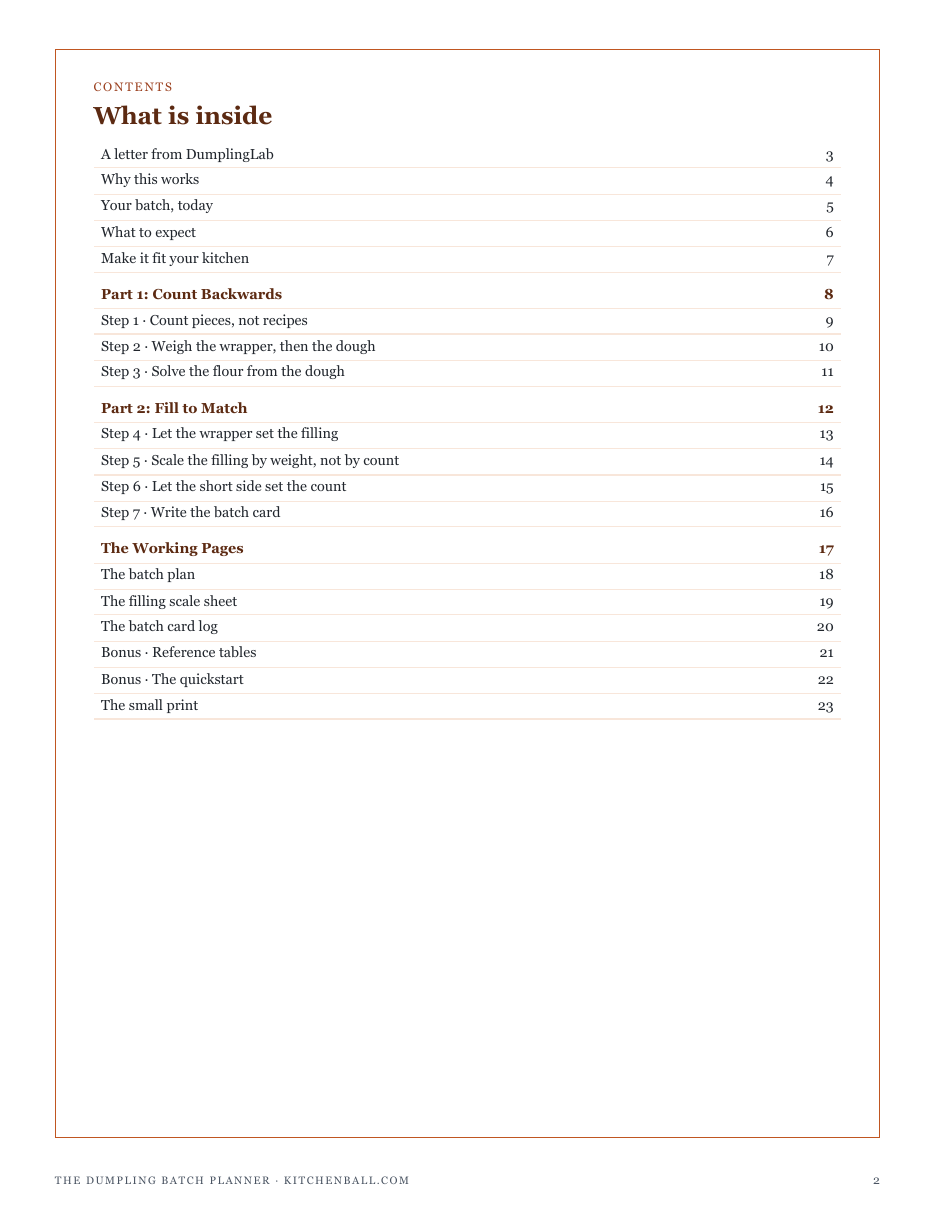
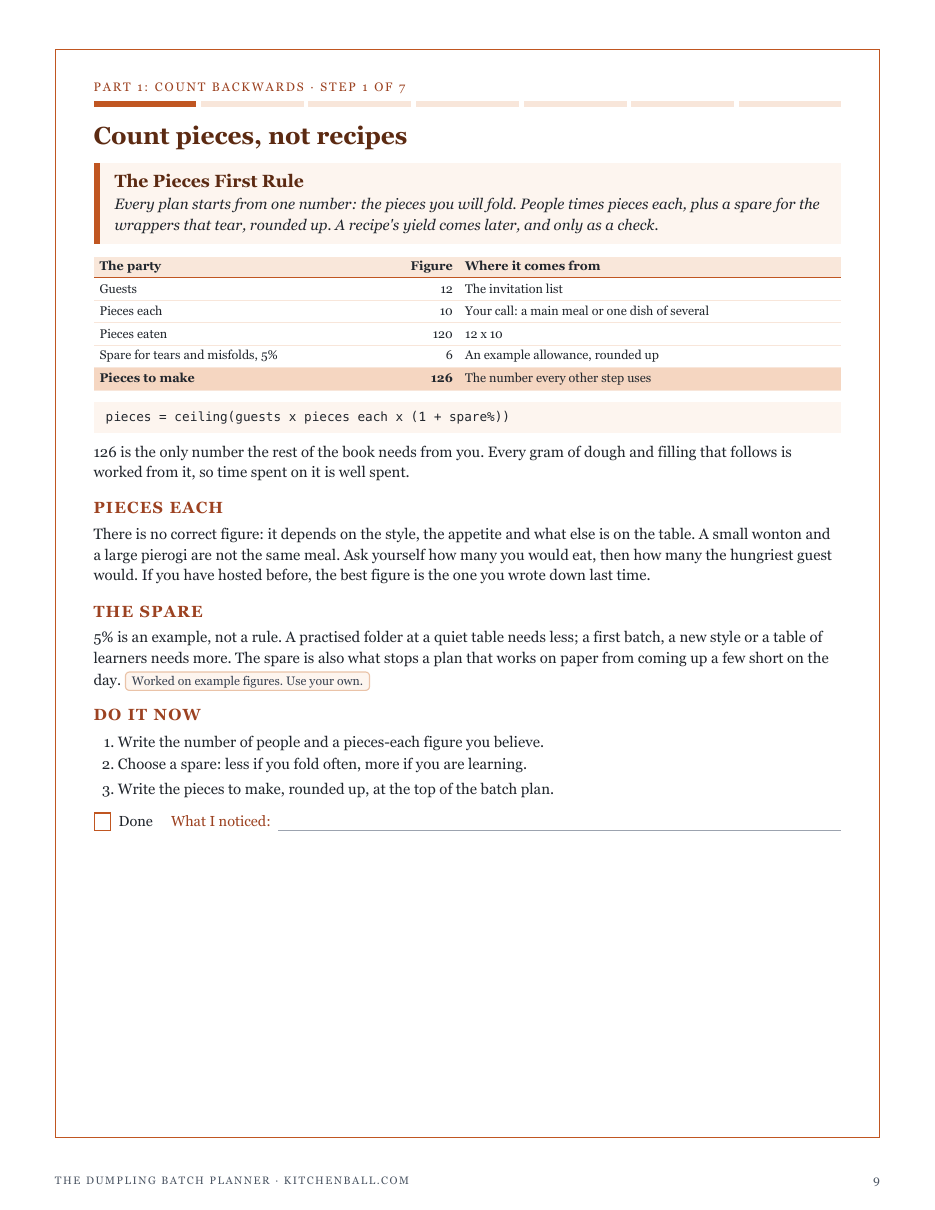
What is in it
- The Pieces First Rule: people times pieces each, plus a spare, rounded up to the pieces to make
- The Wrapper Weight Rule: dough on the board from your own wrapper weight, and the dough to mix after handling loss
- The Flour From Dough Rule: flour and water solved from the dough you need, checked in wrappers
- The Ratio Rule: filling per piece and per batch from the wrapper and your filling-to-wrapper ratio
- The Weight Not Count Rule: the filling recipe scaled by its mixed weight, not its yield
- The Short Side Rule: wrappers and portions counted apart, the plan fixed before you mix
- The Measured Numbers Rule: a batch card with the wrapper, loss and filling yield you really got
- Printable working pages: a batch plan, a filling scale sheet and a batch card log
- Reference tables: flour and water, mixed filling and wrappers for wonton, gyoza, momo and pierogi, plus a quickstart
- A personalised sheet worked from the numbers you enter in our calculators
- ✓ 23 printable pages
- ✓ 10 sections, worksheets and templates
- ✓ A second PDF worked out from the numbers you enter
- ✓ No account needed, just an email address
- ✓ Instant download; link valid 7 days
Price includes any taxes. Sold by GrabURL, who handle checkout and support. The charge appears on your statement as GrabURL.
The planner picks up where the free Wrapper Count Calculator leaves off. The calculator turns a dough weight into wrappers; the planner starts from the pieces you need and works backwards to the dough, the flour and water (with the Dough Hydration Calculator), the filling per piece (with the Filling Ratio Calculator) and a filling recipe scaled by weight rather than by its yield, so the dough and the filling run out together. It is batch arithmetic only, with no cooking times, temperatures or storage advice: cook fillings thoroughly and follow a trusted recipe or food-safety authority for cooking and storage. The party size, spare, handling loss and filling yield in it are examples.